Why Silver Changes Colour in Air
Why silver changes colour in air: learn how tarnish forms at the surface, why its shades vary, and how to distinguish it from ordinary dirt.
Silver changes colour in air because its exposed surface reacts with substances around it, especially sulfur-containing compounds. This tarnish is a thin surface alteration, not a layer of ordinary dirt, and its appearance can shift from a faint yellow cast to deep gray or near-black.
Tarnish begins at the exposed surface
Pure silver is relatively resistant to oxygen under everyday conditions, but it can react with sulfur compounds present in air and in some materials. The resulting silver sulfide forms at the surface. It may develop gradually, and a piece can show the change unevenly because different areas encounter different conditions.
The distinction between surface change and accumulated soil matters. Dust, fingerprints, cooking residue, and skin oils sit on or cling to an object; tarnish is a chemical change in the metal’s outermost surface. They can appear together, so a dull patch is not automatically one or the other.
Air is only part of the surroundings
“In air” is a useful shorthand, not a complete account of where tarnish comes from. Sulfur-bearing compounds may be released by some rubber, wool, felt, paper, and foods, while humidity can influence how readily surface reactions proceed. A silver object stored beside such materials may change more noticeably than one left in a different setting.
Contact and enclosure can matter as much as open display. A drawer lined with unsuitable fabric, a storage box containing sulfur-bearing paper, or a cabinet near a kitchen can create a local environment unlike the room as a whole. The object is responding to its immediate surroundings, not to an abstract average of “indoor air.”
One object can show several shades
Tarnish does not arrive as a uniform coat. Recesses, engraved lines, and the spaces around joins may darken more visibly, while frequently handled or exposed areas can look different. Surface texture, the object’s shape, and past care all contribute to the pattern.
The color can move through pale yellow, brown, gray, and black as the surface changes. Lighting and nearby colors also affect what the eye perceives: a gray patch beside bright silver may look darker than the same patch seen alone. A photograph can exaggerate or mute that contrast, so appearance is best judged in steady, neutral light.
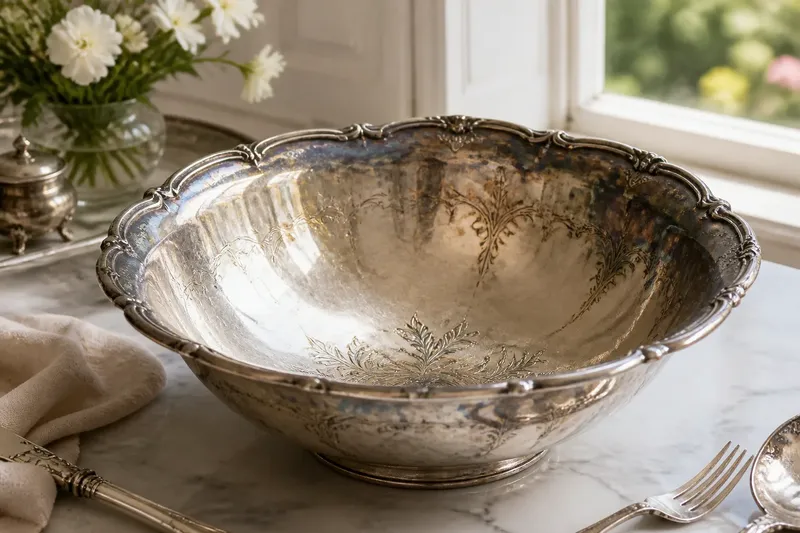
Say you inherit a silver-colored serving bowl with dark lines in its engraved pattern and a cloudy film on the rim. If the lines remain dark while loose dust and fingerprints are visible elsewhere, you may be seeing both tarnish and surface soil; the different appearances do not require a single explanation.
Silver-colored does not always mean solid silver
Many objects that look silver are made from a base metal covered with a thin silver layer, or from an alloy containing silver. Tarnish can occur on silver surfaces in each case, but the construction affects what a surface mark means and how much material is present. A worn spot that reveals a different color underneath may indicate plating loss rather than a new shade of tarnish.
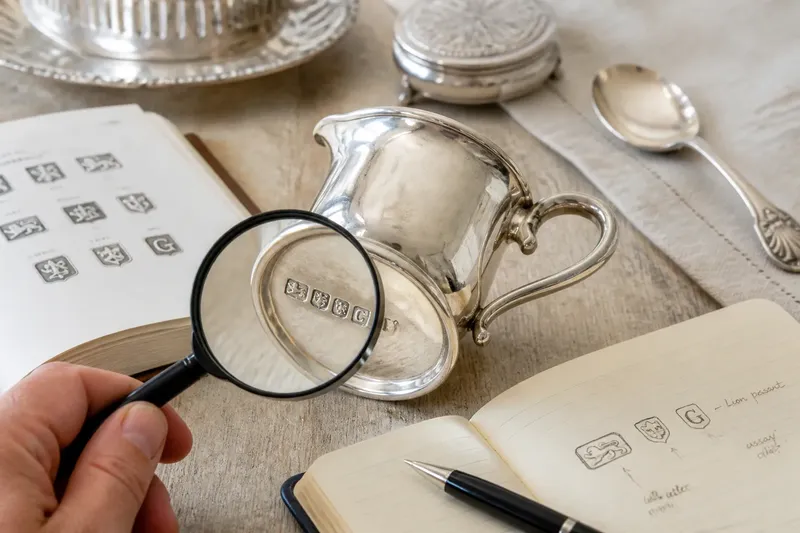
Marks, construction, and visible wear can help distinguish an object’s material, but appearance alone is not a dependable identification method. If an object may be plated, antique, or especially valuable, a conservator or qualified silversmith can assess it before any surface treatment.
Why does tarnish look different from one piece to another?
Why does silver turn yellow or brown before it looks black?
Surface reactions can produce visible shades that vary with the condition and thickness of the altered layer. Lighting and the color of nearby surfaces further shape how those shades appear to an observer.
Why are engraved areas often darker?
Recessed details are less exposed to rubbing and handling, so surface changes may remain visible there. Their shadows also make dark material stand out against a brighter surrounding surface.
Can fingerprints be mistaken for tarnish?
Yes. Oils and residue can leave cloudy or uneven marks, while tarnish is a change in the surface chemistry; both may occur in the same area. A mark’s appearance alone may not settle the distinction.
Does tarnish mean an object is damaged?
Tarnish describes a surface change, but it does not by itself tell you the object’s full condition or value. On a historic, plated, or delicate piece, repeated polishing can remove material, so seek qualified advice if that distinction matters.
Observe the surface before interpreting it
Useful observations are modest: note whether a mark is in a recess or on a raised edge, whether it follows a fingerprint, and whether a differently colored layer shows through a worn area. These clues can help frame a question, but they do not establish the metal or prescribe treatment.
For silver that changes colour in air, the most useful distinction is between a changed surface and material sitting on it. Tarnish can be an ordinary record of contact with its surroundings, while dirt and wear tell different stories. Naming the visible condition carefully helps preserve both the object and the meaning people attach to it.