How a Silver Spoon Becomes a Keepsake
Learn how a silver spoon becomes a keepsake through family stories, inscriptions, and inherited choices, while separating documented history from uncertain claims.
A silver spoon can become a family keepsake when people preserve the story attached to it, not simply because it is old or ornate. The history of a silver spoon often begins with practical clues—an inscription, a maker’s mark, or a relative’s recollection—and gains meaning as those clues are passed on.
Marks and inscriptions offer clues, not a complete biography
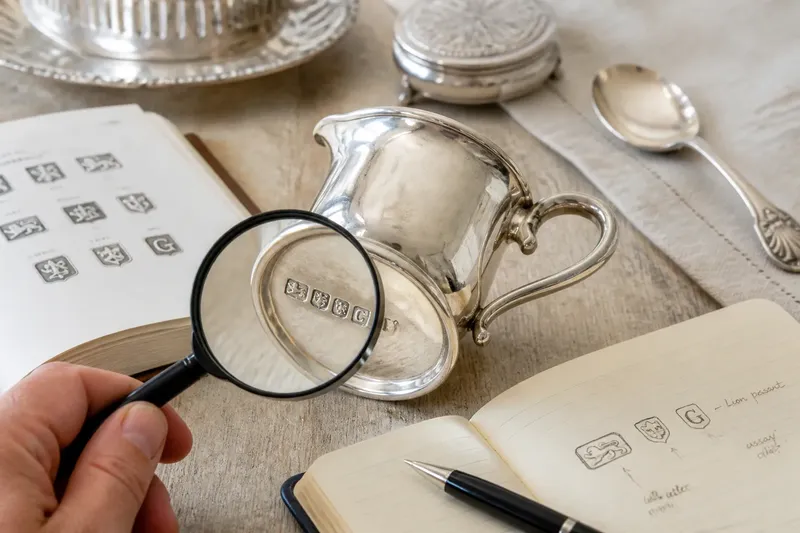
A name, date, or set of initials may connect a spoon to a person or occasion, but it cannot explain everything about the object’s past. Maker’s marks can help identify a place or maker when they are legible and correctly interpreted; they do not, by themselves, establish who owned the spoon or how it traveled through a family.
Keep observations separate from conclusions. A note might say, “Initials M.R. engraved on the handle,” followed by “A relative recalls that this belonged to Margaret.” That wording preserves both the physical evidence and the limits of the memory.
Family memory is strongest when its source stays visible
Stories change as they pass between relatives. One person may remember a spoon at a particular gathering, while another recalls receiving it from an aunt; both accounts can be worth preserving without forcing them into a single, certain narrative.
Record who shared each recollection and, if possible, when. A handwritten note stored with the spoon or a digital document shared with relatives can distinguish a remembered event from a later interpretation. Avoid adding a confident origin story when the evidence is incomplete.
Document a spoon’s history without altering the object
Start with a clear description: the spoon’s shape, visible decoration, inscriptions, and any marks that can be read without polishing or scraping. Photograph the front and back in even light, and save the images with a plain-language note identifying who made the record and what remains uncertain.
- If an inscription is clearly legible, transcribe it exactly; if not, record only the characters you can confidently see and mark the rest as uncertain.
- If a mark is recognizable to a reliable reference, note the reference and the tentative identification; if it is not, photograph it and avoid guessing.
- If relatives agree about a remembered event, record who remembers it; if accounts differ, preserve both versions with their sources.
- If the spoon has a name or date, treat it as a clue to investigate; if no supporting evidence appears, do not present the clue as proof of ownership or occasion.
- If the object’s condition raises questions about handling or food contact, set it aside for advice from a qualified conservator or other appropriate professional; if there is no such concern, choose handling based on its condition and your household’s needs.
- If a family note includes a claim no one can trace, label it as unverified; if later evidence emerges, add that evidence without erasing the earlier account.
Why does a silver spoon become a keepsake?
Does age alone make a spoon a family heirloom?
No. A spoon becomes an heirloom through its place in a family’s history, which may be supported by documented ownership, repeated recollections, or an inscription. Age can be relevant, but it does not supply a personal story on its own.
What should be recorded when a spoon’s history is uncertain?
Write down visible features, exact inscriptions, and who remembers what. Keep guesses clearly labeled so future relatives can tell documented details from family interpretation.
Can a maker’s mark identify a spoon’s owner?
A maker’s mark may help identify who produced the spoon or where it was made, depending on the mark and available references. It does not establish the identity of an owner without separate evidence.
How can relatives preserve conflicting memories?
Record each account with its source rather than choosing one version without grounds. Shared notes can show where memories overlap and where they remain different.
A worked account can preserve both evidence and uncertainty
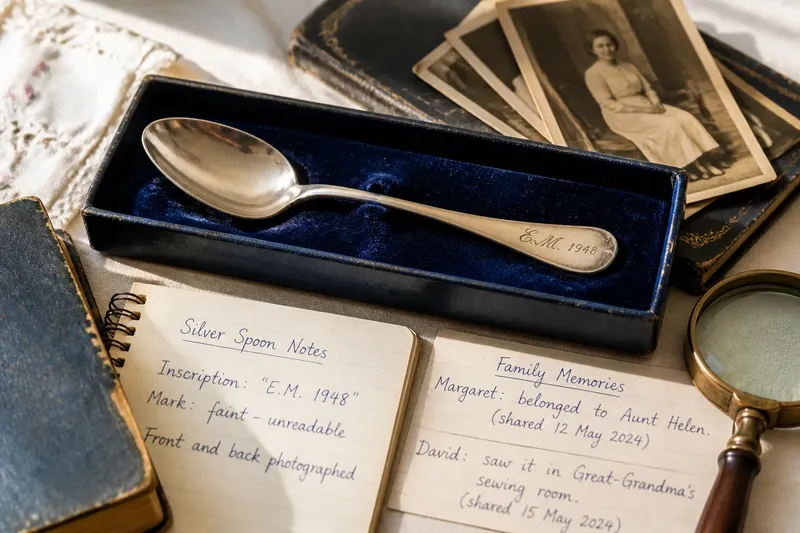
Imagine a family has a spoon engraved “E.M. 1948,” a faint mark on the back, and two relatives with different memories: one says it belonged to an aunt, while the other recalls seeing it in a great-grandmother’s sewing room. The family photographs both sides, transcribes the engraving, records the mark as unreadable, and writes down each relative’s account with their names.
The resulting note identifies what can be observed and where recollections diverge; it does not decide who owned the spoon first. If a reliable reference later helps interpret the mark, the family can add that finding while leaving the ownership question open unless further evidence supports an answer.
A keepsake can carry a careful account rather than a polished legend
The history of a silver spoon is often most useful when it distinguishes what the object shows from what people remember. A dated inscription, a documented transfer, and an uncertain family story can all belong in the record, provided each is described honestly.
Keep the note with the spoon or in a shared family archive, and identify its author and date. That small detail gives future readers a way to understand not only what was remembered, but who remembered it and when.