How to Read a Silver Hallmark Without Overstating Its Meaning
Learn how to read a silver hallmark by recording its marks, checking the relevant system, and separating supported clues from uncertain claims.
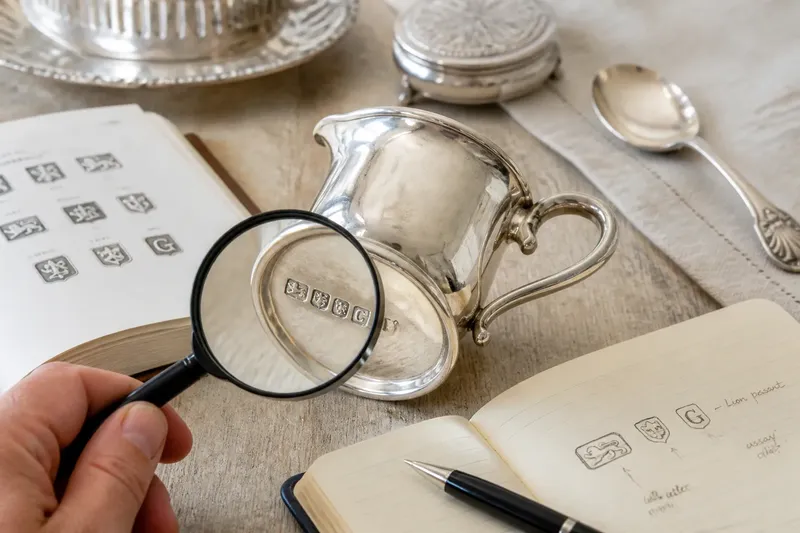
A silver hallmark can help identify an object’s metal standard, marking system, or responsible workshop, but each clue needs to be read in context. On a serving dish or small box, the tiny punches are evidence—not a biography compressed into metal.
A silver hallmark identifies specific claims, not an entire history
A hallmark is a mark applied under a particular system and set of rules. Depending on the place and period, a group of marks may indicate fineness, an assay office, a maker or sponsor, or a date code.
Not every silver object carries a complete set of marks. A single stamp may identify a maker without stating fineness, while another may indicate a silver standard but not name a workshop. Some objects have no visible hallmark because of their origin, size, age, later alteration, or the way they were made and sold.
A number or word that looks official also needs context. “925,” for example, states a fineness claim; by itself, it does not identify where the object was assayed or who made it. The implications of “sterling” and similar wording can vary by location and period.
Record every mark before interpreting the group
Write down each visible symbol, letter, and number, along with its order and position. A phone camera in even light can preserve the arrangement, while a magnifier may help distinguish a faint impression from a scratch or worn edge.
Marks on separate components deserve separate notes. On a spoon, a punch on the handle may not describe the same part as a mark on its bowl; on a small vessel, a detachable lid could have its own marking history. Do not assume that every stamp applies to the whole object.
- Fineness mark: Check whether the mark states a silver standard or uses a recognized symbol. If it matches the relevant system, record that as a metal-standard clue; if it does not, leave the fineness claim unresolved.
- Maker or sponsor mark: Compare the exact shape and lettering with references for the relevant place and period. If the match is specific, record the business or sponsor as a possibility; if several marks resemble it, keep the attribution open.
- Assay or place mark: Check the symbol against the jurisdiction’s marking system. If it matches, describe it as evidence of that system or testing location; if not, do not infer where the object was designed, made, or used.
- Date mark: Compare the letter or symbol’s shape, border, and neighboring marks with the applicable sequence. If the whole group fits, record the supported date range or marking date; if a feature is missing or worn, leave the date undetermined.
- Secondary mark: Look for retailer names, inscriptions, repair stamps, or import marks. If a mark appears to be secondary, record it separately from official assay symbols; if its role is unclear, describe only what is visible.
- Mark placement: Check whether each punch sits on the main body, a handle, a lid, or another component. If marks appear on different parts, interpret those parts separately; if they are on one piece, still avoid assuming they share a date or purpose without supporting evidence.
Marking systems are not universal. Consult a reference for the relevant jurisdiction rather than transferring a familiar symbol’s meaning from one country to another.
Symbols can change meaning across systems and periods
A letter, animal, crown, or geometric shape can mean different things in different systems, and symbols may be reused over time. Even within one system, a date code or maker’s mark can depend on its sequence, border, or neighboring symbol.
Wear adds uncertainty. Polishing can soften a shallow punch, while a scratch can make a worn mark resemble another letter. A close photograph helps preserve what remains visible, but cannot restore details that have disappeared.
A mark may also be copied, added later, or found on a replacement component. Compare it with the object’s construction, joins, and fit of separate parts. A stamp is one clue among several, not a substitute for examining the object.
Connect the marks to the object without turning clues into a biography
Separate direct observations from interpretations. “Three punches beneath the foot; the first resembles a lion passant; the final letter is unclear” describes visible evidence. “Made in London in a particular year” goes further and needs a secure reading of the relevant marking system.
Then check whether the object’s shape and construction fit the proposed interpretation. Look for a replacement handle, later engraving, repair, or marks on a component that could have been changed. These details may expose a mismatch, even if they do not identify a maker.
Imagine you inherit a small silver-colored cream jug with worn punches beneath its base. You photograph the marks, note their position, and compare them with a reference for the apparent system; one symbol seems to match an assay office, but a second is too worn to read. Your resulting description is “a jug with marks consistent with that system; maker and exact date unresolved,” rather than a confident family story built on the uncertain symbol.
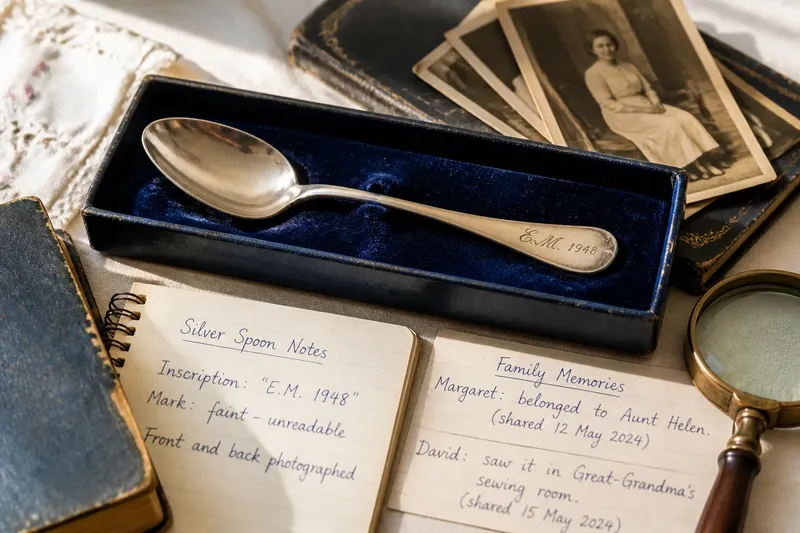
Keep family accounts distinct from mark-based evidence. A note that a relative used the jug may be meaningful provenance without identifying its maker; a maker’s mark may point to a workshop without revealing who owned or used the piece.
A hallmark cannot settle age, ownership, authenticity, or value
A readable date code may refer to a marking event, not necessarily the moment an object was designed, ordered, or first used. Repairs and later assembly can also give different components different histories.
A maker’s mark does not automatically mean that the named person performed every stage of the work. It may represent a workshop, company, retailer, sponsor, or other responsible party under the system in use.
Nor does a hallmark alone establish authenticity or value. Attribution, condition, completeness, workmanship, demand, and documented history may also matter. If a purchase, sale, insurance decision, or family dispute depends on the answer, consult a qualified appraiser familiar with silver and the relevant marking tradition.
Which silver hallmark questions need a closer look?
Does a sterling mark prove that an object is solid silver?
It is evidence of a claim about the metal, but the wording alone does not establish the object’s full composition or authenticity. Consider the rest of the marks and the object itself; for a consequential identification, consult a qualified specialist.
Can a hallmark tell you who made an object?
A recognized maker’s or sponsor’s mark may point to a named business or workshop. It does not necessarily identify the individual craftsperson, and similar initials should be matched to the correct system and period before attribution.
Does a date letter give the exact year?
Only when its shape and surrounding marks fit the relevant system and sequence. Similar letters may recur, so a date should not be assigned from one letter in isolation.
What if an object has no hallmark?
The absence of a visible mark does not prove that an object is silver or that it is not silver. A mark may be missing, worn, obscured, or never applied under the system involved; use other evidence and seek professional assessment when needed.
To read a silver hallmark responsibly, preserve the marks as they appear, identify the system before interpreting them, and separate observations from conclusions. That record gives future owners room to revise an attribution while keeping the object’s physical evidence and human history distinct.