Hammered, Cast or Formed from Sheet: Three Ways to Shape Silver
Compare hammered, cast, and sheet-formed silver to see how each method shapes surface, structure, and repeatability, and choose an approach for your design.
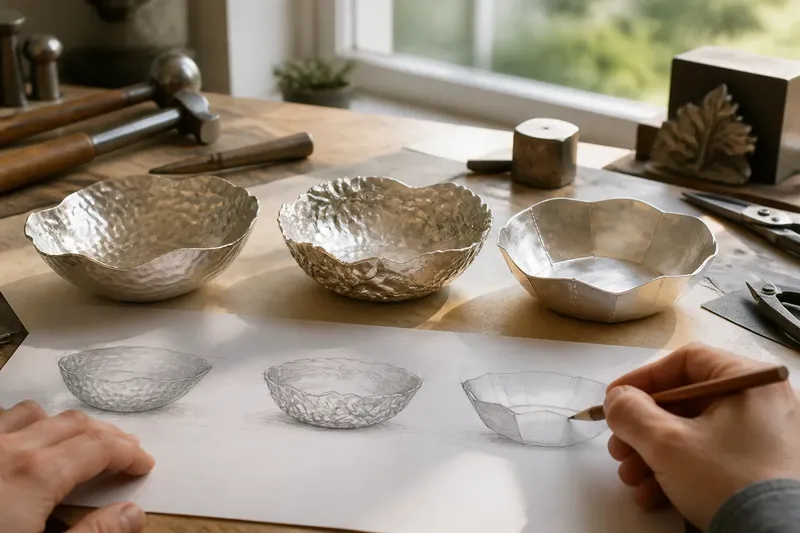
Hammered, cast, and sheet-formed silver can serve the same purpose while making different claims about touch, structure, and repetition. A hand-raised bowl carries traces of controlled blows; a cast handle can hold contours that would be difficult to build from flat stock; a folded sheet body may emphasize crisp planes and joins.
These differences are useful to recognize when looking at an object or planning a design. The discussion here is about how each method tends to shape an object’s character, not a workshop procedure: casting and hot-metal work involve equipment and hazards that call for appropriate training and precautions.
Hammering makes the working rhythm visible
In raising, a silversmith shapes a flat disk over a stake or form with a sequence of controlled blows. Planishing uses lighter, more regular strikes to refine the profile and surface. The methods are related, but the result depends on how the maker moves the metal and manages its changing condition.
Hammered surfaces often show small facets that catch light unevenly. A gently shifting profile may feel responsive rather than mechanically uniform, because the marks are consequences of shaping as well as surface finish. They can be deliberate, but variation alone does not prove that an object was raised by hand.
For a viewer, the useful distinction is between a coherent rhythm of marks and a surface whose marks distract from the form. Consistent spacing and direction can make the working pattern legible; irregular marks may instead be part of an intentionally rough character. Polishing is only one possible finish, not an automatic improvement.
Repeated deformation also changes how silver responds to further work. That matters to makers, who need the relevant knowledge and equipment to manage the metal safely; it is not something an observer can reliably diagnose from appearance alone.
Casting allows contours to begin in a mold
In casting, molten silver enters a prepared mold and solidifies into a rough form. A mold can capture deep relief, undercuts, or clustered details that would be awkward to raise from sheet. The casting still needs finishing, and visible seams or remnants of the casting process may be altered afterward.
Because details can emerge from one mold, a cast object may feel visually unified. Yet unity does not guarantee a sound design: a narrow transition between a handle and a body, for example, may look graceful while appearing structurally vulnerable. In design terms, the response is to reconsider that transition before making the casting, rather than assume surface polishing will resolve it.
Small voids or rough patches can have several possible causes, including casting or finishing conditions. Appearance by itself may not identify the cause or the appropriate repair. For an object with damage or uncertain construction, a qualified silversmith can assess whether a localized repair is suitable or whether the form needs more substantial work.
Casting can support repeated complex forms, but repetition does not make every surface identical. Mold preparation, metal flow, cooling, and finishing can all affect the result. The process may produce less visible variation than direct hammer work, though later surface treatment can add a deliberate texture.
Sheet forming emphasizes planes, edges, and joins
Sheet silver can be cut into a blank, bent around a former, pressed into a die, or joined with other sections to make a hollow object. Its relatively uniform starting material suits crisp edges, repeated components, and designs organized around planes.
A broad panel can appear visually light, while a sharp bend may draw attention to a transition in the form. If a design asks a thin wall to carry a strong visual or physical role, the maker may rethink the outline, add a fold or reinforcement, or choose different stock. The right decision depends on the intended object and its use, rather than a single rule for every piece.
Joins also shape the object’s character. A seam may be discreet or intentionally visible; a misaligned seam can interrupt the profile and make the object look unfinished. Looking closely at where edges meet often reveals more about the design than a general impression of polish.
For a family of related objects, a shared pattern can help preserve proportions across pieces. Hand finishing can still introduce small differences, so a repeated design need not produce identical surfaces.
Choose a forming method by the character you want
The methods are not rivals, and one object can combine them. A cast handle might meet a sheet-formed body, or a raised vessel might receive a separately made rim. The choice concerns where the design needs variation, complex detail, or controlled repetition.
- Look for hammering when visible working marks and a changing contour suit the object; if the marks form a consistent rhythm, read them as part of its surface character, but if they interrupt the form, consider whether later finishing has altered the original effect.
- Consider casting when the design depends on intricate relief or geometry that is difficult to build from sheet; if details flow together, the mold may have established them as one form, but if the transitions look weak, avoid assuming that polish alone explains or fixes the issue.
- Consider sheet forming when clean planes, controlled edges, or related components matter; if seams align with the design, they can clarify how the object was assembled, but if they appear to distort the profile, compare the joins from more than one angle.
- Look for combined methods when different parts have different visual demands; if a component’s surface or contour differs from the body, treat that as a clue to inspect the join, but do not claim a specific process from appearance alone.
- Compare the intended use before judging a form; if the object’s edges and transitions appear suited to its role, assess the whole design, but if damage or instability is visible, ask a qualified silversmith rather than infer a repair from the forming method.
- Separate surface from structure when inspecting a piece; if marks appear only as texture, describe them as surface evidence, but if a crack, gap, or loose join is present, treat it as a condition concern and seek a professional assessment.
Say a maker is planning a small serving dish and, for this invented design situation, starts with the goal of a shallow body and an intentionally irregular rim. The maker compares three options: a cast dish could integrate a relief motif but would place the irregularity in the mold and finishing; a sheet blank could establish a controlled body, while raising and planishing could shape the rim; a wholly hammered form could make both body and rim show the working rhythm. Given the stated priorities, the design decision is to use sheet for the body and hand raising for the rim, accepting that the surface will show more variation than a uniformly cast version.
What clues help distinguish the methods?
Why can hammered silver look less uniform?
Each blow moves a local area of metal, so the maker’s sequence can leave small differences across a surface. Those variations may be intentional, but marks alone do not establish how the entire object was made.
Can cast silver have a hand-worked surface?
Yes. Casting establishes a base form, and later finishing can alter its surface. A viewer can describe visible marks and transitions, while avoiding a firm claim about the process when those clues are ambiguous.
Does sheet-formed silver always weigh less than cast silver?
No. The method alone does not determine an object’s weight; its design, wall thickness, and added components matter too. A visual impression of lightness is not enough to establish how much silver a piece contains.
Which method suits a repeated design?
Sheet forming can help maintain related profiles, while casting can reproduce complex contours from a prepared mold. Hammered work can also be repeated, but visible variation may remain part of each piece’s character.
Read surface and structure as clues, not proof
When comparing hammered, cast, and sheet-formed silver, look beyond whether a piece appears polished or rustic. Notice where planes change, how edges meet, whether details recur, and whether the visible marks support the object’s form. These observations can suggest how the silver was shaped, but appearance is not definitive proof of one process.
The most useful question is where the object allows variation and where it seeks control. Hammering may place variation in the surface, casting may concentrate detail in the mold’s contours, and sheet forming may make bends and joins prominent. For hammered, cast, or sheet-formed silver, that distinction helps you describe what the object shows without mistaking a visual clue for certainty; when condition or repair is at issue, let a qualified silversmith assess the piece.